
East Hampton Drinking Water Questions and Answers
Information regarding Perfluoropropionic acid (PFPrA) detections in Suffolk County Water Authority (SCWA) public water supply wells and the ongoing New York State Department of Environmental Conservation (NYSDEC) and Suffolk County investigation
Last updated: July 21, 2026
|
What You Need to Know • PFPrA, a type of PFAS, was detected in drinking water wells operated by the Suffolk County Water Authority. • Three of four wells with PFPrA were removed from service at its Buckskill Road wellfield. One well is available for emergency use only. • Suffolk County Department of Health Services is testing private wells identified within the area being investigated. • The NYSDEC and Suffolk County investigation of PFPrA in the area is ongoing. The source of the contamination may be related to a 2023 battery storage fire. |
Questions and Answers
Does the water currently being delivered by SCWA meet public drinking water standards?
The water currently being delivered to customers meets all drinking water standards. SCWA removed three of the four impacted wells located in its wellfield at Buckskill Road from service and has restricted the use of the fourth well.
What should residents with private wells do?
Suffolk County Department of Health Services (SCDHS) has contacted households with private wells in the area being investigated and began free well testing for those properties.
Residents who believe their property may be within the affected area, or who have questions regarding private well testing, should contact the Suffolk County Bureau of Drinking Water at 631-852-5810. Residents should follow the guidance provided by County health officials based on their testing results.
Residents may also contact SCWA Customer Service at 631-698-9500 to connect to public water, particularly if the levels in their private wells are found by SCDHS to be elevated.
How do I know whether my property is served by SCWA or a private well?
If you receive a water bill from SCWA, your property is served by the public water system. If you are unsure, contact SCWA Customer Service at 631-698-9500.
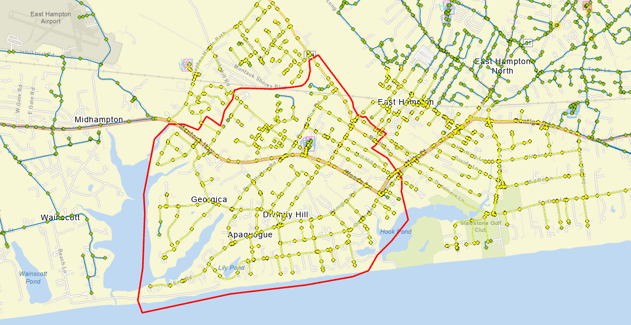
Where is the area of concern for private well owners and SCWA customers?
What is PFPrA?
PFPrA is an ultra-short-chain member of the larger family of chemicals known as Per- and polyfluoroalkyl substances (PFAS). PFPrA is not a listed emerging contaminant and is not routinely sampled for. The Town has been informed that SCWA was first able to sample its water for PFPrA in early 2026 through its specialized laboratory testing.
Unlike PFOA and PFOS, which have public drinking water standards, PFPrA has no specific standards and is considered an unspecified organic contaminant (UOC). The health effects of PFPrA are still being studied. NYSDOH is recommending a site-specific screening level of 3 parts per billion (ppb) when evaluating detections of PFPrA in drinking water testing. This screening level is more specific to PFPrA than the “catch-all” limit of 50 ppb for a UOC.
Where was PFPrA detected?
SCWA detected PFPrA in its four public water supply wells in its wellfield located at Buckskill Road in East Hampton earlier this year above New York State’s UOC level of 50 parts per billion. These wells had supplied about 7 percent of water to customers in the area. Wells have been taken out of use for public drinking water and water is now supplied to SCWA customers from other unaffected public drinking water supply wells in the area.
The SCWA is now only using one of the affected wells for emergency purposes based on water quantity needs.
SCWA has published testing information, an affected area map, and well data on its East Hampton Battery Storage webpage.
After SCWA detected PFPrA earlier this year, SCDHS conducted groundwater sampling and detected PFPrA and other PFAS, including PFOS, in groundwater in the area.
Were other PFAS detected?
Yes. To better understand PFAS contamination in the area, the SCDHS sampled untreated groundwater from test wells that are hydraulically upgradient of the Buckskill Road wellfield results showed PFOS levels of 2,774 parts per trillion as well as other PFAS in these groundwater wells. DEC, DOH, and SCDHS are evaluating the source of the PFOS, and no source has yet been found.
Has the source of the contamination been determined?
No. As described below, an investigation is underway to determine if the PFPrA detected in the SCWA wells resulted from a 2023 fire at the East Hampton Energy Storage Center. SCWA has filed a federal lawsuit against companies associated with the facility.
At the same time, the Town understands that DEC, NYSDOH, and Suffolk County are investigating and examining the energy storage facility and may analyze other potential sources. The Town will continue to work closely with the appropriate environmental and public health agencies throughout this investigation.
Why was PFPrA not identified following the 2023 battery fire?
Municipalities throughout the State rely on NYSDEC for its authoritative expertise to determine how a site should be investigated, and for its findings, directions and approval.
Following the fire, NYSDEC, in 2023, investigated the battery storage site for the presence of metals contamination and determined that no additional action was required after it was determined that there was no discernible difference between results of soil samples collected where the fire water runoff discharged compared to soil samples collected in the vicinity that was unimpacted by fire water runoff. The Town understands that NYSDEC did not analyze samples for PFAS at that time since it was determined that aqueous film forming foam (AFFF) was not used to treat the fire. Even if NYSDEC had done such sampling, however, the samples would not have been analyzed for PFPrA because, even today, PFPrA is not on NYSDEC’s analyte list of 40 PFAS compounds. This is because reliable laboratory analysis for PFPrA was not available until very recently.
SCWA says it began sampling for ultra-short-chain PFAS compounds in January 2026 using specialized laboratory methods and shut down the wells shortly thereafter.
The Town is continuing to seek a complete understanding of the contamination, including how and when it developed and what additional action is necessary.
What is the timeline of events?
What did the Supervisor and Town Board do upon learning of the contamination?
PFPrA was not detectable using commercially reliable analytical methods until this year. The Town learned of the contamination when SCWA filed its lawsuit against East Hampton Energy Storage Center in late May 2026.
Upon learning of the contamination, the Supervisor sent a letter to the Governor, Commissioner of New York State Department of Health, Commissioner of New York State Department of Environmental Conservation, the Suffolk County Executive, Commissioner of Suffolk County Department of Health Services and Suffolk County Water Authority calling for the formation of a joint task force to ensure residents’ drinking water and the groundwater are protected. NYSDEC continues to convene the parties regularly to coordinate on the PFAS investigation and resolve issues and concerns.
What is the Town doing?
The Town has brought together State, County, local, and Water Authority officials to coordinate the response. The Town’s priorities are:
- Protecting the drinking water supply
- Supporting private well testing
- Identifying and containing the source of contamination
- Ensuring adequate replacement water or treatment
- Keeping residents informed as new information becomes available
The Town has also called for government resources to be coordinated so that the cost of addressing the contamination does not fall unfairly on residents.
What can residents do?
Water conservation is always a good idea. Residents are encouraged to water their lawns on an odd/even schedule based on their house number, meaning an odd-numbered house (23 Hickory Street) should water its lawn on July 23rd but not July 24th. That is because SCWA can pump less water due to the wells that SCWA shut down. SCWA may issue further drinking water conservation alerts.
What are the roles of the various government agencies involved?
NYSDEC: State regulator tasked with investigating and remediating environmental issues with regulatory enforcement power. NYSDEC investigated the East Hampton Energy Storage Center in 2023 and is renewing that investigation in light of the recent detections.
SCDHS: Often works hand in hand with NYSDEC where environmental contamination is suspected or at issue in Suffolk County, particularly when private drinking water wells may be impacted. SCDHS is in the process of sampling private wells in the area and conducting groundwater sampling in the area.
SCWA: Supplies public drinking water to customers that meets all drinking water standards. Where contamination is detected, SCWA engages in remedial action by, among other things, placing treatment on its public drinking water supply wells or installing new wells.
Town of East Hampton: Local municipality that has convened the joint task force and relays information to residents.
NYSDOH: NYSDOH’s Center for Environmental Health and Bureau of Water Supply Protection provides technical assistance to SCDHS when addressing contamination issues including when there are detections of PFAS. DOH establishes drinking water standards called MCLs and guidance or screening levels to help evaluate detections in drinking water.